


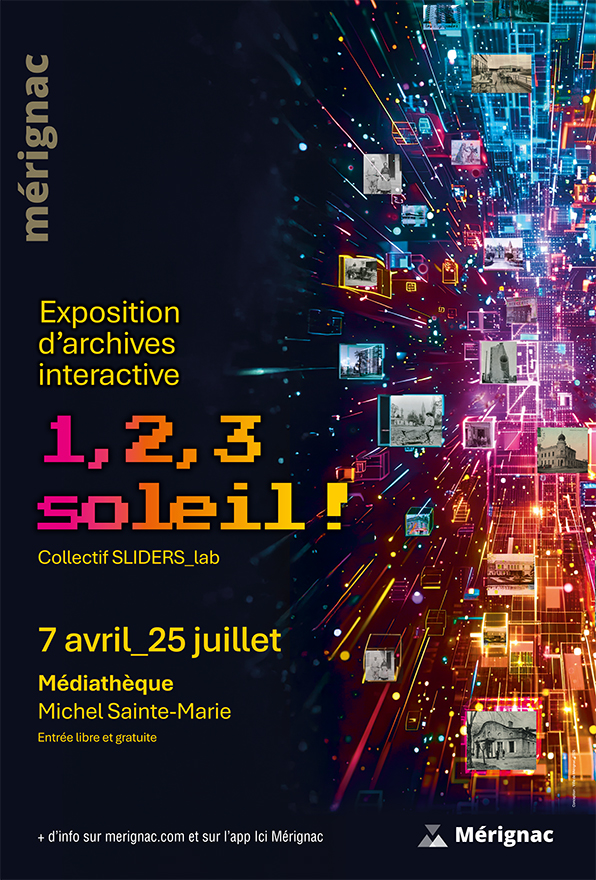
1, 2, 3, soleil !
From 7 April to 25 July
The digital society in which we live, shaped by a globalised platform industry, has made data—and its large-scale storage and processing—one of the cornerstones of its functioning and wealth creation. Many of us now have accounts on Instagram, Facebook, X (formerly Twitter), LinkedIn and other social media platforms, which we use to share and comment on information that, as soon as it is published, is stored and archived on servers in data centres scattered across the globe. A projection of the amount of data stored on the world’s servers yields the staggering figure of 21 ZB. Everything seems destined to be stored and to remain there for eternity. The entire planet seems to be suffering from that famous affliction which the philosopher Jacques Derrida called the ‘mal d’archive’: a tension between the desire to preserve, to keep everything, and a countervailing force of erasure, destruction and repression.
However, this contemporary regime of digital over-archiving does not in itself create these tensions: it simply makes the processes at work in any archive more visible, on a different scale.
The focus of SLIDERS_lab’s examination of the Mérignac archive, through the exhibition *em*1, 2, 3 Soleil! , is twofold: to examine what has been preserved, and the institutional, political and practical reasons behind this preservation; but also, since every archive shapes memory as much as it limits it, to identify what has been left out, forgotten, marginalised, or even rendered illegible. It would indeed be misleading to regard the archive as a neutral repository. To archive is to select, classify, name, prioritise, and organise the conditions of access: all operations that shape what can become a narrative. In *Mal d’archive*, Derrida invokes the figure of the ‘archon’ to designate those who hold authority over the archive, safeguard it and regulate its interpretation, because they also establish its order and law. Consequently, working with an archive—or visiting an exhibition that engages with it—is by no means innocent: what is at stake are the frameworks of visibility and regimes of legitimacy that allow certain narratives to prevail, at the risk of perpetuating a ‘grand narrative’ to the detriment of peripheral, dissonant or inconvenient histories. It is precisely this framework, often presented as self-evident, that SLIDERS_lab has chosen to examine from an oblique rather than a head-on perspective, in order to reveal its rough edges, grey areas and points of friction.
Six original installations created in 2026 thus revisit the archives of the town of Mérignac: ToponymIA / Punctum temporis / Temporal Navigation 2: Mérignac / Timelines / The Shadows of the Washerwomen / 1, 2, 3, sun!
Ultimately, SLIDERS_lab’s work on the Mérignac archive transforms the staged elements from mere documents into cultural objects imbued with meaning: a symbolic meaning, shaped by an artistic form and laden with values. This meaning only becomes fully effective when it meets the public, when the public recognises, in these traces and arrangements, references, narratives or tensions that resonate with their own cultural frameworks, memories and experiences. The exhibition therefore has a twofold aim: to highlight aspects of Mérignac’s culture whilst respecting its essence, whilst also offering a critical interpretation that creates a sense of distance and opens up a space for discussion.
<
Credits
• Design and Art Direction : Frédéric Curien, Jean-Marie Dallet
• VR design and programming : Loïc Almeida
• Design and manufacture of turntables : Yann Grolleau
Production
• Town of Mérignac. Archives Department, France.